

Braces or clear aligners: what’s right for your family comes down to case complexity, age, and wear habits. Braces use fixed brackets and wires that work day and night, so they don’t rely on compliance. Clear aligners are removable trays worn 20 to 22 hours daily, and they suit mild to moderate cases and older teens or adults.
Both methods do the same core work: applying gentle, continuous force that guides teeth into better positions over months of supervised care. The difference is delivery. One is bonded on and always working, and the other comes out for meals, brushing, and the occasional school photo.
Personal preference matters, but it usually isn’t the deciding factor. At Emily Funk Orthodontics, Dr. Emily Funk looks at the bite, the stage of growth, the crowding, and how a specific kid, teen, or adult is likely to handle daily responsibility before recommending one over the other.

How Braces and Clear Aligners Move Teeth
Both appliances rely on the same principle: light, continuous force applied over time under orthodontic supervision. Braces move teeth with brackets bonded to each tooth and an archwire that Dr. Funk adjusts at periodic visits. With clear aligners, a series of custom trays does that work instead, each one worn 20 to 22 hours a day and swapped every one to two weeks.
The mechanics differ, but the biology behind them does not, which is one reason neither option can be rushed.
With braces, the process looks like this:
- Brackets are bonded to the front surface of each tooth.
- An archwire connects the brackets and holds the shape you’re moving toward.
- Wires and elastics get changed or adjusted at regular visits.
- Teeth follow the wire, a little at a time, until the bite settles into place.
With clear aligners, the process looks like this:
- A 3D scan captures your teeth without any goopy trays.
- Dr. Funk maps every planned movement digitally before a single tray is made.
- You wear each tray 20 to 22 hours daily, removing it only to eat and brush.
- You switch to the next tray on schedule, and each one moves teeth slightly further.
Both approaches often need help from extras. Elastics correct how the top and bottom jaws meet. Aligners frequently use small tooth-colored attachments that give trays something to grip. Some growing kids need a palatal expander first, and select cases call for temporary anchorage devices.
Visits usually land every 6 to 10 weeks for either option. Some check-ins can happen remotely when things are tracking well, which saves families a drive.
Benefits of Each Option
Each treatment has real strengths. Here’s what tends to matter most to families.
Braces work well when you want reliability:
- They’re bonded on, so treatment progresses whether or not anyone remembers a tray.
- Complex bite corrections, severe rotations, and large gaps respond predictably.
- Clear braces give teens and adults a lower-profile look with the same fixed control.
- There’s nothing to lose in a lunchroom, a backpack, or a hotel room.
Clear aligners work well when lifestyle is the priority:
- They come out for meals, so popcorn, bagels, and corn on the cob stay on the menu.
- Brushing and flossing stay normal, which helps kids and teens keep gums healthy.
- Smooth plastic means no wires and far fewer poking emergencies.
- They’re nearly invisible, which matters to a lot of adults in meetings and photos.
- The tray-change schedule is predictable, so busy families can plan around it.
One honest tradeoff: aligners only work while they’re in the mouth. A tray sitting in a case during lunch period isn’t moving anything.
Braces trade convenience for consistency. Aligners trade some control for freedom. Neither is better across the board, and orthodontic treatment is not one size fits all.
Braces vs Clear Aligners: A Side-by-Side Comparison
| Factor | Metal & Clear Braces | Clear Aligners |
|---|---|---|
| Appearance | Visible; clear braces are more discreet | Nearly invisible |
| Comfort | Some soreness after adjustments; wires can irritate cheeks | Some pressure with each new tray; no wires or brackets |
| Hygiene | Brushing and flossing take more time and tools | Remove trays, brush and floss normally |
| Compliance needed | Low; works on its own | High; 20 to 22 hours daily |
| Food rules | Avoid hard, sticky, and chewy foods | No restrictions when trays are out |
| Visit frequency | Every 6 to 10 weeks | Every 6 to 10 weeks, some virtual |
| Emergencies | Loose brackets and poking wires happen | Rare; a lost tray is the usual issue |
Which option is best for kids in Phase I treatment?
Younger children with narrow palates, crossbites, or crowding usually do better with fixed appliances and expanders. Baby teeth are still shedding, and trays don’t track well on a mouth that’s changing month to month.
Which option is best for teens?
Aligners can be excellent for a responsible teen who keeps trays in. If wear time is a question mark, braces remove that variable entirely and protect the timeline.
Which option is best for adults?
Mild to moderate crowding, spacing, and old relapse cases are strong aligner territory. Deep bites, open bites, and significant jaw discrepancies often call for braces or a combination approach.
Here’s something families are often surprised to hear: when both options are clinically appropriate, treatment time is usually comparable. Complexity drives the calendar far more than the method does.
What Affects the Cost of Braces and Clear Aligners
The cost of braces and clear aligners depends on three things: case complexity, treatment length, and the appliance your case requires. Extractions, expansion, and bite correction all add time, and added time adds cost. Insurance benefits, FSA or HSA dollars, and flexible financing then change what your family actually pays each month.
| Cost Factor | Why It Matters |
|---|---|
| Case complexity | Mild alignment costs less to correct than a full bite correction with extractions or expansion |
| Treatment length | Longer cases mean more visits, more wire changes, or more aligner trays |
| Appliance type | Metal braces, clear braces, and clear aligners carry different lab and material costs |
| Added appliances | Expanders, elastics, and anchorage devices affect the total |
| Insurance benefits | Many plans include a lifetime orthodontic benefit that offsets a portion of the fee |
| Retention | Retainers and follow-up monitoring belong in your total, not as a surprise later |
Two people can walk in with crowded front teeth and leave with very different quotes. One might need eight months of aligners. The other might need eighteen months of braces plus an expander.
That’s why Emily Funk Orthodontics doesn’t post a single price. A free consult with Dr. Funk produces an exact fee for your case, along with flexible financing that spreads it across the length of treatment.
Ask about insurance verification at that first visit. It takes a few minutes and it’s worth knowing your number before you decide.
Who Is a Good Candidate for Braces or Clear Aligners?
Clear aligners tend to be a strong fit for:
- Teens and adults with dependable habits who’ll keep trays in 20 to 22 hours a day
- Mild to moderate crowding or spacing
- Relapse after previous orthodontic treatment
- Adults who need a discreet option for work or social reasons
- Musicians who play wind or brass instruments
- Anyone who wants to keep eating whatever they like during treatment
Braces tend to be the better call for:
- Significant bite discrepancies, including deep bites and open bites
- Severely rotated or impacted teeth that need precise control
- Younger children still losing baby teeth
- Kids or teens who realistically won’t manage tray wear
- Cases where treatment simply can’t afford lost time
Growing children sometimes need Phase I treatment before either option is on the table. A palatal expander widens the upper jaw so it matches the lower jaw, and it works best while the two halves of the palate are still separate. According to the American Association of Orthodontists, children should have a first orthodontic check-up by age 7, which is when problems like crossbites and crowding first become visible.
As a general benchmark, complete cases most often run somewhere in the 12 to 24 month range regardless of appliance, with straightforward alignment finishing sooner and complex bite correction taking longer. Dr. Funk gives you a case-specific estimate rather than an average once the records are in.
Adults who had braces years ago and skipped retainers often finish faster than they expect. Mild relapse frequently responds to a short course of aligners.
In select cases, supporting therapies help too. Some patients dealing with jaw tension or clenching benefit from adjunctive care, including cosmetic injectables for TMJ symptoms, alongside their orthodontic treatment.
None of this is diagnosable from a mirror. An exam with a 3D scan, photos, and X-rays is what confirms candidacy.
What Happens at an Evaluation for Braces or Clear Aligners
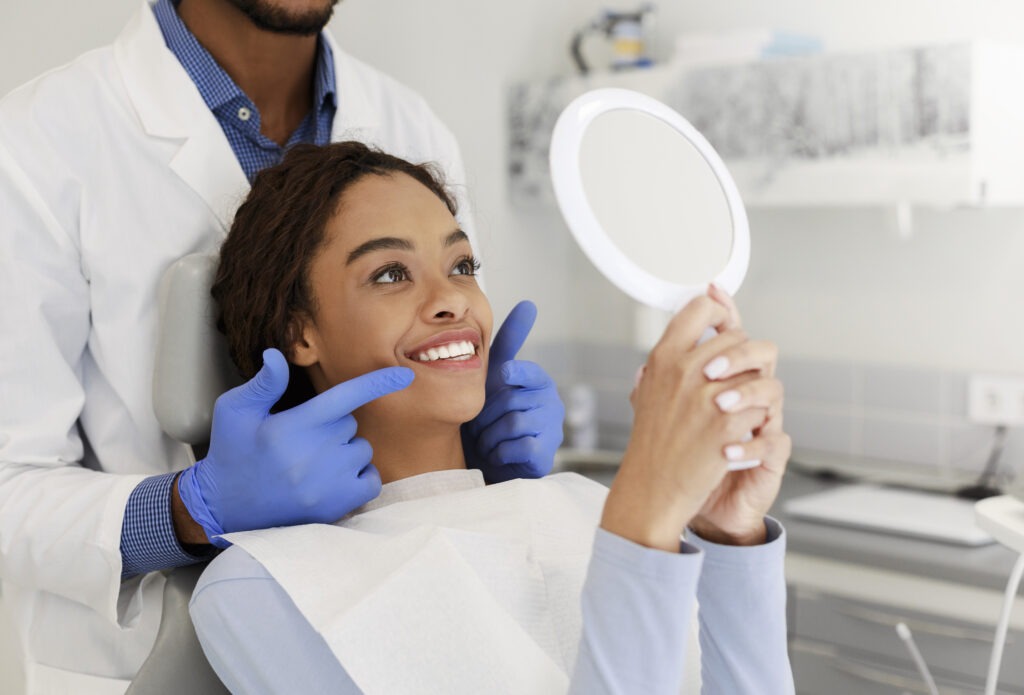
Choosing between the two isn’t guesswork, and it isn’t something you can settle in front of a bathroom mirror. An evaluation gathers the records that make the answer clear: a 3D scan of both arches, photographs, and X-rays that show root position, jaw relationship, and how much growth is left.
Dr. Emily Funk is a board-certified orthodontist (American Board of Orthodontics) and a member of the American Association of Orthodontists.
Emily Funk Orthodontics runs on a simple model: one doctor, one location. The same person who plans your treatment is the same person adjusting your wires and reviewing your aligner tracking at every visit, so nothing gets handed off or re-explained from scratch.
Digital scanning replaces old-fashioned putty trays, so digital impressions are quick and comfortable.
Families who find it hard to get in can start with a virtual consult instead and come in once the basics are covered. Either way, the first visit is an exam and a conversation rather than a commitment, and you leave knowing which appliances suit the case, roughly how long treatment should take, and the total cost. Gathering that information costs nothing but a little time, and there’s no reason to wait on it.

Frequently Asked Questions
Are clear aligners as effective as braces?
For mild to moderate crowding, spacing, and many bite issues, clear aligners deliver clinical results comparable to braces. The two variables are case complexity and wear time. Aligners only move teeth while they’re in the mouth, so a patient averaging 12 hours a day won’t get the planned outcome. Complex rotations and large bite discrepancies still favor braces in many cases.
How long does treatment take with braces versus clear aligners?
Most complete cases fall somewhere in the 12 to 24 month range with either option, though shorter and longer cases both exist. Simple alignment can wrap up in well under a year. When both treatments are clinically appropriate for the same case, timelines are usually similar. Complexity drives the calendar more than the appliance does.
Can my teen play sports or a musical instrument with braces or aligners?
Absolutely, with a couple of adjustments. Athletes in braces should wear an orthodontic mouthguard, which fits over brackets and protects lips and cheeks on contact. Aligner wearers remove trays for contact sports and wear a mouthguard instead. Wind and brass players sometimes need a few weeks to adapt to braces, while aligners come out entirely for practice and performances.
Do clear aligners hurt less than braces?
Most people describe aligners as more comfortable, mainly because there are no brackets or wires rubbing against the inside of the lips. You’ll still feel pressure and tenderness for a day or two after switching to a new tray. Braces cause similar soreness after adjustments. Both settle quickly, and orthodontic wax handles most irritation from braces.
Can you switch from aligners to braces mid-treatment?
Yes. If teeth aren’t tracking the way the plan called for, or if wear time slips, Dr. Funk can shift the approach. Some cases even use both, starting with braces for the heavy lifting and finishing with aligners. Changing course mid-treatment isn’t a failure, it’s just a course adjustment based on what your teeth are actually doing.
Will my child still need a retainer afterward?
Yes, regardless of which treatment you choose. Teeth have memory and will drift back toward their old positions without retention. Nightly retainer wear protects the work you both put in. Plan on retainers as a permanent part of the routine, not a temporary step, and factor replacement retainers into your long-term thinking.